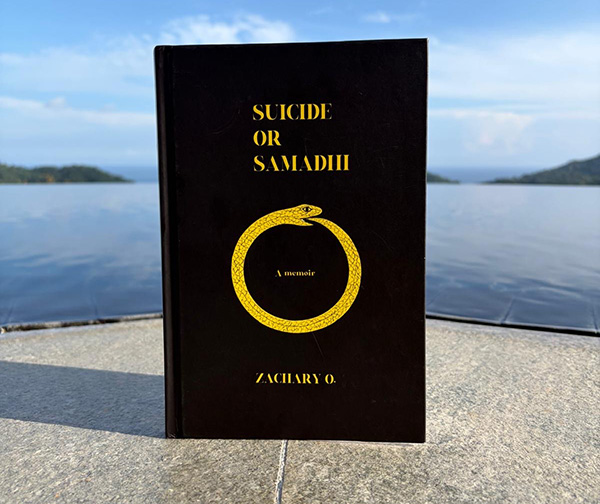
A Memoir of Dying Before You Die
I was thirteen when I first heard of someone taking their life.
A year later I heard of another.
A friend of a friend in Paris who’d left a simple note saying “sorry for the mess.”
Then there was the sweet boy who wrote poetry. The singer, and more recently the sister who I’d sat next to at a wedding a few years prior, and had thought – with her wild and piercing eyes – kindred spirit.
As an adult I still never got used to it. Every one, whether I knew them or not, always stopped me in my tracks. Had me immediately wondering, involuntarily, what more could have been done, what was overlooked, what other approaches might have helped? What did we miss?
Now, from having worked with many considering it, as well as parents who have undergone the agony of enduring it, I know these are questions we sometimes never stop asking, and for which there are often no answers.
Sometimes it’s just a quiet self-flagellation for the guilt we feel for having not done enough, even when we did everything we could.
For the longest time I would simply imagine that as they were approaching that final, fateful moment – crossing over that most sacred of thresholds – that they were held, honored, and that there was some deep, sanctified meaning to their gesture, some plan of greater healing that they were contributing to as souls, for all of us, as they fell.
Then again, maybe this was simply the story I told myself to soften the unbearable.
Either way, this is the backdrop for the first installment of a recently published memoir exploring a lifetime of psycho-spiritual transformation, beginning with my own dark night at twenty-seven.
~
This inaugural volume explores the first major psycho-spiritual transformation in life that falls at the threshold of what astrology calls the Saturn Return – a developmental portal during which many of us undergo our first comprehensive reorganization of identity.
This period strikingly coincides with what is also known in popular culture as the 27 Club – that tragic constellation of artists who died at twenty seven, including Hendrix, Morrison, Joplin, Cobain, Winehouse, and countless unknown others.
Over the course of my career, I have repeatedly witnessed the damage of avoiding, suppressing, pathologizing, or simply failing to adequately support what are often essential developmental, and archetypal, transformations of psyche during this time. Transformations which, when obstructed, inevitably result in anxiety, addiction, depression, illness, and in the most heartbreaking of cases, suicide.
Much of my own therapeutic work over the years has involved supporting individuals to navigate these thresholds effectively. That being said, many continue not to have such support, and simply repress the transformational invitation of their first Saturn Return, hoping that once the storm has passed, all will be well. Often it is not.
Psycho-emotional pressures continue to accumulate over the course of our lives, and while some manage to contain them indefinitely (not without adverse consequence upon their bodies and families) the more empathic and psychically porous individuals among us often encounter their resurgence with even greater force during subsequent midlife transits – including the Uranus opposition around forty, and Saturn opposition at forty five, when divorce, psychiatric crisis, and all manner of mental breakdowns are common.
Much of this, I believe, is the result of having lost our rites of passage. As many of us know.
Spring break is not a rite of passage. Neither is fraternity hazing, nor taking risks with our bodies through extreme sports, nor with our minds through the recreational use of drugs – all of which are more often then not degraded forms of sacred ritual, and what we might call “shadow” rites of passage, many of which I engaged in myself as a young person.
In many of these experiences, we are not simply thrill-seeking, but attempting, often unconsciously, to undergo transformational processes that will usher in new capacities, embodiments, and existential orientations which we need, and are unconsciously seeking, to meet the ever increasing demands of life.
Such transformations become increasingly necessary as we are called, over the course of our lives, to navigate ever greater complexity, carry increasingly burdensome psycho-emotional material, and ultimately confront our own mortality, all as natural and inevitable consequences of simply being human.
Without such rites of passage, however, intentionally and thoughtfully undertaken, many risk misinterpreting the agonies they are going through as something to escape rather than messages to understand.
In doing so, they may end up “literalizing” their own psycho-spiritual death-and-rebirth process by actually taking their lives in a tragic, reductive enactment of transcending their persona, and aligning with the Self – what the Sufis call fanāʾ, and what is more commonly understood as dying before you die, so that, in the words of St. Francis, “the second death shall do you no harm.”
What is often diagnosed as “suicidal ideation”, and certainly around the time of the Saturn Return, is often simply the result of such transformations having been overlooked, misunderstood, or overmedicated, without any understanding of the underlying process attempting to effectuate. All of which causes ever increasing psycho-emotional strain on the individual, and family, that is often completely unnecessary.
Ever since going through my own version of this at twenty-seven, I have felt increasingly called to offer my story to others facing their own existential crisis, in the hopes of supporting the growing understanding of these transformational rites of passage, and returning them to their rightful place in culture.
Why The Medium of Memoir
The reason I chose to write the book as a first-person memoir also merits a brief explanation.
When I was in the depths of my own hell, the last thing I wanted to read was a how-to book. Nothing would have nauseated me more than to be met with a measured explanation of how to reframe my desire for self-destruction by taking deep breaths, watching my thoughts, and practicing gratitude.
What I really wanted, what I desperately needed, was to encounter someone who had been on their knees, and could tell me in intricate detail, how they found their way out.
For all its faults, this is the book I have attempted to offer others. An honest retelling of what took place when I myself was in the midst of my darkest night, and how I found my way to the other side.